Think about a song or album that got you through a hard week. The one you turned up in the car, or played on repeat at two in the morning when nothing else helped. Most of us have one. Music has a way of reaching us when words are still out of range.
That instinct is real, and there is a whole clinical discipline built on it.
Music therapy is one of the services we are proud to offer at Carolina Dunes Behavioral Health in Leland, North Carolina. If you are coming to us for care, or helping a loved one get here, you may be wondering what this actually involves. We’ve provided a brief overview in this post, but encourage you to reach out to our admissions office for more information about the care options that are available.
What Music Therapy Actually Is
The American Music Therapy Association defines music therapy as the clinical, evidence-based use of music interventions to accomplish individualized goals inside a therapeutic relationship, delivered by a credentialed professional who has completed an approved music therapy program. Jadyn Bergner, MT-BC, Activity Therapist/Music Therapist at Carolina Dunes, puts it simply, “Music therapy allows us to reach nonmusical goals through the use of music as an evidence-based practice.”
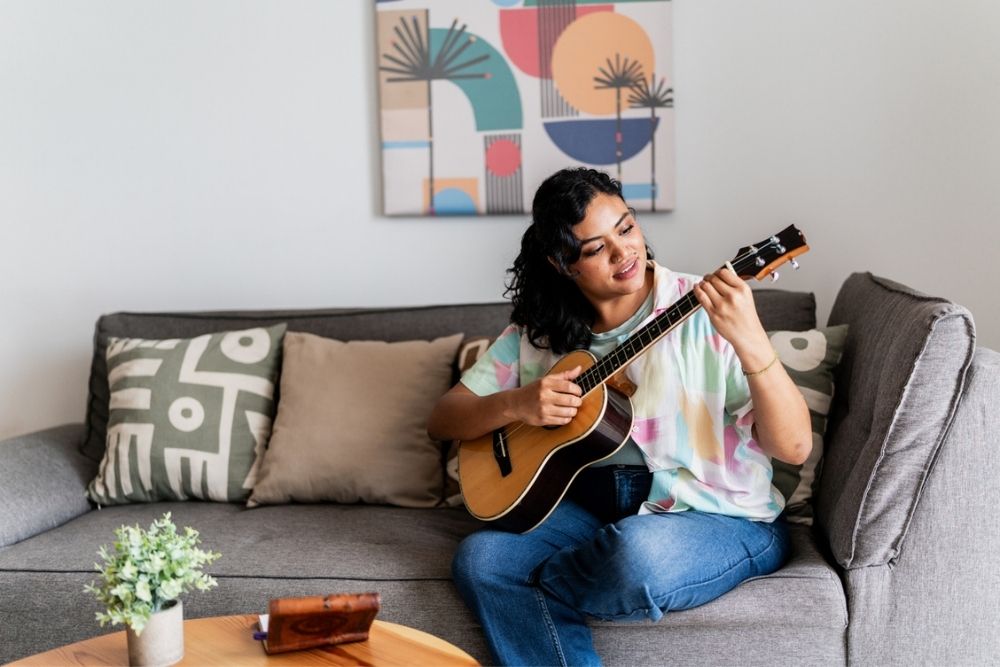
With music therapy at Carolina Dunes, the goal is not to make you a better singer or teach you how to play an instrument. The goal is to help you understand your own anger, sit with a feeling without running from it, or find one more tool for the moment when everything feels like too much. Music is the path. Your life outside the hospital is the destination.
“Music is used so frequently in our life that it can be seen as mundane. However, music is anything but mundane, ” Jadyn said. “It is complex and completely unique to the individual listening or creating. It is a way of life, and culture, and love, and identity for so many people. Music is so much more than sound, and music therapy is so much more than a role.”
What a Music Therapy Session at Carolina Dunes Looks Like
According to Jadyn, a typical music therapy session generally has two distinct parts:
- The feelings check-in. This opens the session and doubles as an assessment. It gives each person a way to name where they are, and it gives the music therapist leading the session real information about each person’s needs in terms of creativity, emotional identification and regulation, motor skills, and active listening. It also shapes everything that follows. If the room walks in heavy, the session meets the room where it is.
- The main intervention. This changes based on the goal. It might involve songwriting, lyric analysis, instrument play, improvisation, or guided listening. Common goals include developing problem-solving skills, increasing self-awareness, practicing coping strategies, and defining what mindfulness actually means in practice rather than as a social media buzzword.
One thing is worth saying plainly: you do not need any musical ability to benefit from music therapy. You don’t have to sing. You don’t have to read music or have touched an instrument since you learned how to play “Hot Cross Buns” on the recorder in fourth grade. If you can listen, you can do this work.
How Music Therapy Can Help Support Your Mental Health Treatment Goals
The benefits of music therapy include:
- Preventing relapse. Sessions create space to name the situations, feelings, and patterns that tend to come right before a setback, and to rehearse a different response while there is still support in the room.
- Connecting medication to what you actually want. Sticking with a treatment plan is easier when it’s tied to something personal rather than to someone else’s instructions. Music therapy helps link the daily work of recovery to the life you’re trying to get back to.
- Building coping and leisure skills. Coping tools only help if you’ll reach for them at 2 a.m. Music therapy helps you find ones that fit you, and it reintroduces the idea that rest and enjoyment are part of staying well, not a reward for it.
- Strengthening problem-solving. Group interventions put real, low-stakes problems in front of you—a song to finish, a rhythm to fix, a decision to make with other people—and let you practice working through them.
Music also has a way of reminding us of the parts of ourselves that get buried under the challenge of day-to-day survival. For example, we all use critical thinking every day, but we tend to get stuck in one groove. Music therapy can nudge you toward more creative and flexible ways of solving the problem in front of you. That flexibility then shows up in how you handle a conflict at home, a craving, or a bad day three months from now.
Why it Matters That a Board-Certified Therapist Leads Music Therapy Sessions
Music therapy is not automatically good for everyone. It can be as harmful as it is healing. A song can carry someone straight back into a memory they were not ready to revisit. When there is trauma involved, well-meaning music exposure without clinical training can do real damage.
That is exactly why a credentialed music therapist is an essential part of what makes a music therapy program successful. MT-BCs complete an approved academic program, clinical training, and a national board certification exam. They are trauma-informed. They are trained to recognize when a song is opening something painful and to help the person process it, redirect, and move forward safely.
How Music Therapy Fits in With the Rest of Your Care
Carolina Dunes Behavioral Health provides humanistic, client-centered care with a strong emphasis on trauma-informed treatment. Music therapy fits naturally inside that approach, which is part of why it is such a flexible service—it can adapt to what a treatment team and a patient need.
Here, music therapy is a supportive and integral part of programming rather than an add-on. It can be delivered in groups or one-on-one, and it works well alongside other therapies and services. Music therapy may be used in collaboration with recreational therapy, art therapy, dance therapy, speech therapy, occupational and physical therapy, counseling, and child life or play therapy.
Request a Free, Confidential Assessment
You don’t need to make any decisions today, but a free, confidential assessment can be a good step if you think you or a loved one might benefit from our treatment services. Assessments are available 24/7. Reach out today to get started.